


|
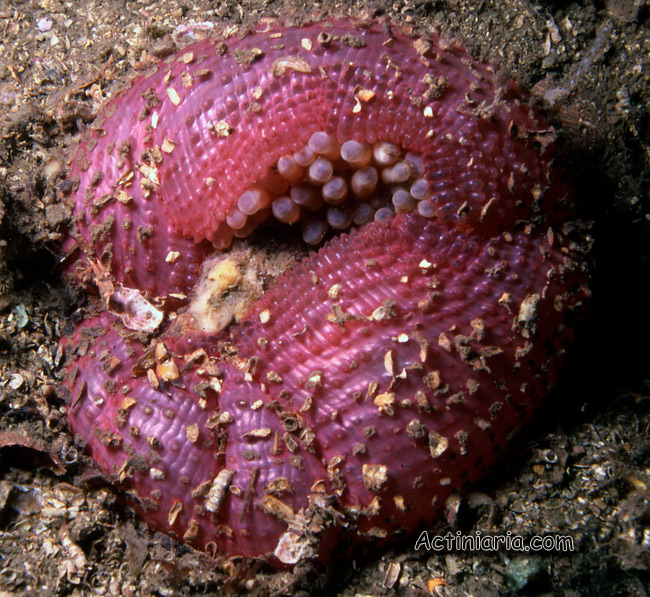
This is a very interesting and distinctive species.
Originally, we described is as a new species from British Columbia (Pacific coast of Canada; see reference below) and assigend it to the genus of Urticina, but later established a new genus, Urtibrina and transferred all former Urticina and Cribrinopsis species to a separate family - Tealidae.
Its distribution along the Pacific coast of North America is likely much wider, but this requires confirmation. The species is always found buried in coarse sand or gravel, with the pedal disc attached to solid objects like stones or rocks. Only the oral disc and tentacles are visible on the surface; contracted specimens are typically hidden by overlying sediment.
It occurs from the low intertidal zone to depths of 20 m. Externally, in photos, it resembles Cribrinopsis olegi in its buried habit and short, decamerously arranged tentacles, though living specimens differ clearly in coloration and tentacle shape (more ampullaceous in Cribrinopsis olegi).
A similar (or possibly partially conspecific) species along the Pacific coast of the USA and Canada is often misidentified as Urticina coriacea. This name is invalid being a junior synonym of Urticina felina, a species restricted to European waters and not present in the Pacific.
Full description of this species is in this paper:
Sanamyan N, K. Sanamyan, N. McDaniel, 2013. Two new shallow water sea anemones of the family Actiniidae (Cnidaria: Anthozoa: Actiniaria) from British Columbia (NE Pacific).- Invertebrate Zoology, 2013, 10(2): 199-216.
This publication contains key to all known Urticina, Urtibrina and Cribrinopsis
Sanamyan N.P., Sanamyan K.E., McDaniel N.G., Kukhlevskiy A.D., Bocharova E.S., 2025. A new genus and species of sea anemone (Cnidaria: Actiniaria) related to Urticina, with the reinstated family Tealidae Hertwig, 1882 and keys to genera and species. Invertebrate Zoology, 2025, 22(2): 219–236.
|

